Holy Mary of Graces
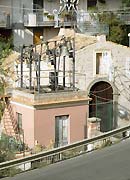
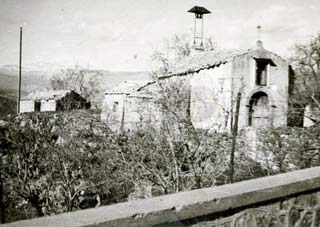 The rural little church of Holy Madonna of The Graces is located beyond the urban perimeter; set at the entry of the town (coming from Adrano) and stands on a strongly sloping ground, boxed in with respect to the provincial road. Architecturally the church is very simple and compact. The rural little church of Holy Madonna of The Graces is located beyond the urban perimeter; set at the entry of the town (coming from Adrano) and stands on a strongly sloping ground, boxed in with respect to the provincial road. Architecturally the church is very simple and compact.
It exists since the XVI° century, as it appears in the writings of the time that remember the pastoral visit of the Monreale bishop Monsignor Torres in 1574 (the "Liber visitationis").
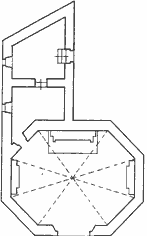
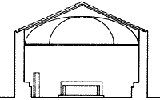
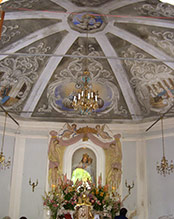
The building has volumetric simple and unitary shape; with no architectural style of its own, but an octagonal typology, very unique in his kind in Bronte, gives her an interesting aspect.
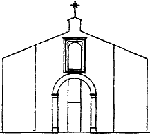
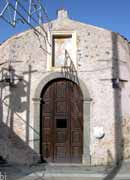
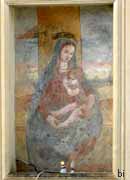
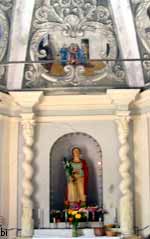
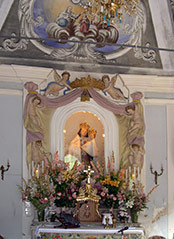
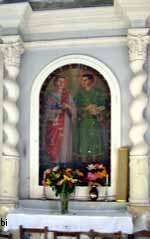
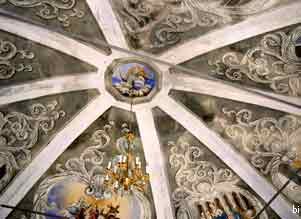
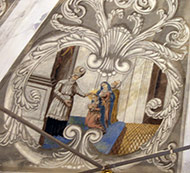
At the entry a rectangular aedicule contains the image of the Madonna that stands over a big lava round arch portal. The inside, also very simple, work by Nicolò Dinaro (Biancavilla, 1834 -- Bronte, 1908) has a roof turned to "umbrella" with frescos of 1896 representing the Marriage of the Virgin, the Annunciation and the birth of Jesus, work of Nicolò Dinaro (Biancavilla, 1834 - Bronte, 1908). "Here, within the squares arranged around the Eternal, leap the plentiful but quick ornamentation of white and gray circles that frame and animate somewhat, the scenes of the Virgin's life". (Vito Librando). There are three altars dedicated to the saints Cosma and Damiano, to San Domenico (work by Carlo Laccati) and, the central one, to the Madonna delle Grazie (Holy Madonna of The Graces).
At the back, there are two small rooms, once sacristy, that now are used as storerooms.
Lately the little church, like many other churches of Bronte, is in a state of nearly abandon; is visited by believers only few times a year on the recurrence of the Madonna of the Graces and other Saints. And this has always been. Even the historian of Bronte Benedetto Radice wrote in the early decades of 1900: "On the day of the titular party, the clergy make the solitary church echo with songs and prayers". |



 You are in: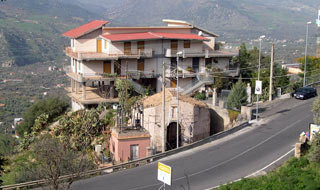


 Powered by DLC for Ass. Bronte Insieme / Reproduction not permitted even if partial - Last adjournment: 04-2024

