The inside
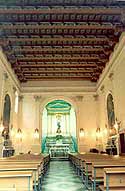
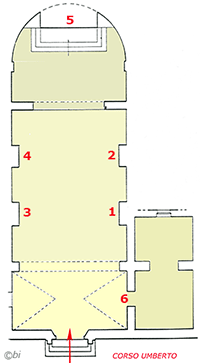 The inside is typical in Bronte's churches, one only hall with semicircular apse and cantor's place that impends over the entry zone of the nave. The inside is typical in Bronte's churches, one only hall with semicircular apse and cantor's place that impends over the entry zone of the nave.
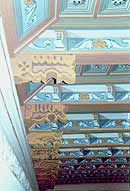
The nave, rectangular, is surmounted by a truss of remarkable dimensions with inclined rafters and wood-floor and a carrying plot supported by wooden shelfs sculpted to anthropomorphic forms. The apse has a barrel vault with spherical head. The decoration of the wooden ceiling is of Nicolò Dinaro (son of the brontese painter Giuseppe Dinaro) with showy geometrical, floral and grotesque motifs.
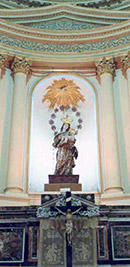
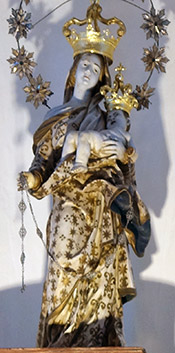
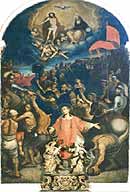
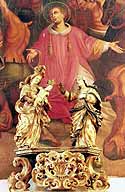
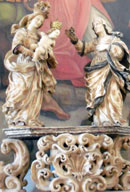
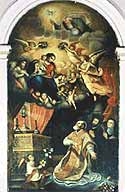
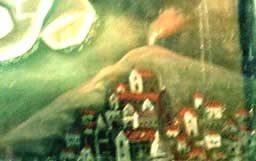
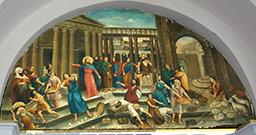
A little chapel, to left coming in, of which can still be seen mouldings and frames, it was restructured and modified to build above it the cantor's area which is close to the entry of the nave. The church has five altars. The first, to right, is the chapel of the Madonna Of The Mercede, to follow there is the San Filippo Neri altar. On the right the chapel of the Cinque Piaghe (Five Sores) and the altar of Saint Stefano (with a little marble group of the Virgin with the child to whom Sant' Anna offers a bunch of grapes). In the niche of the major altar, between duplicated Doric columns and above tympanum, stands the marble statue of the Madonna della Catena or Santa Maria Of The Snow (that the Radice judges of the Gagini school). A painted marble coat of arms is found under the statue. Two pictures adorn the church (representing San Filippo Neri and Saint Stefano) executed in 1876 by the brontese Agostino Attinà (copies from two bigger originals). On the altar dedicated to S. Stephen (the second to the left) there is a big picture of the classic school showing the lapidating of the Saint (measuring 4,25 x 3,50 m.). The brontese historian Benedetto Radice writes that «truly beautiful is the head and the pose of S. Stephen and of the people who were stoning him to death» and that it was a copy made by Agostino Attinà in 1876 from an original painting by father Giuseppe Tommasio of 1646. On the same altar there is a small marble group of the Virgin with the child to whom Saint Anne offers a bunch of grapes. To note, down to the right of the picture showing S. Phillip Neri, a pleasant view of Bronte with its churches and mount Etna impending over as background. Benedetto Radice writes (in his "Historical Memories of Bronte") that on August 5 the brontesi still «remember with pain the dreadful slaughters and fires of 1860; and they also remember with pride than on the flight of steps of the church, the people caught up and killed in September 16 of the 1820, the baron Palermo." who had come to assail the country, with more than two thousand soldiers, for having Bronte joined Palermo against the Borbon».
Some small curiosity
Until 1582 in front of the church there was the gallows (later shifted to the “Scialandro”). It was father Antonino Castronovo, general visitor of the Montréal’s archbishop, who, when he came to Bronte the 12th of February 1582, ordered «to remove the gallows placed in front of the church and replace it with a cross and if any military captain would try to use it again to hang somebody, should be told that he could be excommunicated.» Radice writes that «…the people of Bronte remember with pride that, on the steps of the church, on the 16th of September 1820, caught and killed the captain Baron Palermo who, under command of the Prince of Catena, had came with the captain Zucchero, to attack the town with more than two thousand soldiers, for the simple reason that Bronte had joined Palermo against the Bourbons.» 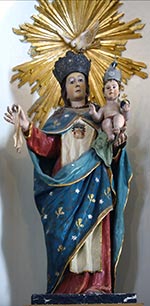 It is also worth citing the devotion (by now almost disappeared and obsolete) and the prayers that Bronte’s peasants for centuries turned to Maria SS. della Mercede. The statue of the «Maronna Miccera» is placed on an altar dedicated to her; it is made of painted papier-mâché, 140 cm high and was made during the 19th century. It was carried in procession whenever a drought threatened the harvest. It is also worth citing the devotion (by now almost disappeared and obsolete) and the prayers that Bronte’s peasants for centuries turned to Maria SS. della Mercede. The statue of the «Maronna Miccera» is placed on an altar dedicated to her; it is made of painted papier-mâché, 140 cm high and was made during the 19th century. It was carried in procession whenever a drought threatened the harvest.
This is what the local newspaper “Il Ciclope” was writing during the fifties: «Viva la Madonna della Mercede» (Hurray for the Mercedes Madonna). «Finally the so wanted rain has arrived! Never before so many peasants, intellectual middle class and workmen had asked with so much trepidation the sky, overcast since many days, for some rain. Great was the anguish that clasped the hearths for fear of famine, for scarcity of bread other great scourge in times so unlucky. Everywhere in the Continent rain had fallen abundantly, even causing heavy damages: while in the blessed land of God a tremendous drought had disheartened everybody. But the Sicilians hearth is firm and its faith strong. Everywhere solemn vows were made to God, to the Virgin and to the Saints.
In Bronte hundreds and hundreds of believers went to implore for a miracle by the Mercedes Madonna, the Virgin who, pressing to her breast her divine son in an embrace of love and protection, has granted their vows, The rain has come! Hurray for the Mercedes Madonna! Men and women were shouting nearly in tears for the great joy – Be blessed, gentle our Mother! Hurray for your Mercy! The rain was wetting some wrinkled face of old peasant, turned to the sky, and gets mingled with its tears gushing out from his hearth open now to the greatest joy.» (Il Ciclope, year II, n. 7 (19) of the 13th of April 1947)
The first brontese school to read and write
The Little Seminary 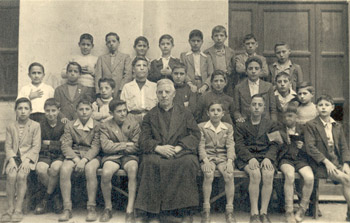 Next to the Chiesa della Catena (on the right) there is now the Little Seminary (well-deserving Institution founded in1922 by father Giuseppe Salanitri) and the ancient San Carlo Oratory (with a fair number of 17th century pictures) seat of the same San Carlo confraternity founded during the XVI century. Next to the Chiesa della Catena (on the right) there is now the Little Seminary (well-deserving Institution founded in1922 by father Giuseppe Salanitri) and the ancient San Carlo Oratory (with a fair number of 17th century pictures) seat of the same San Carlo confraternity founded during the XVI century.
The Little Seminary was once the seat of the ancient San Filippo Neri Oratory. The Oratory of S. Phillip Neri was built, adjoining the church, during the first years of 1600, together with the Philippine fathers who, for centuries, performed activities of elementary instruction (“Little Grammar School”) in favor of needy class. | 



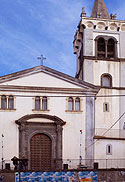
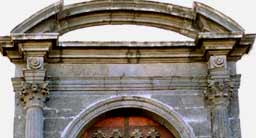
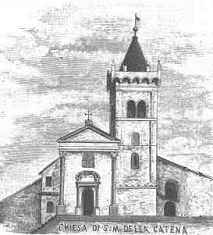 The church of Santa Maria Of The Chain ("Santa Maria della Catena") was founded in 1569, by the generosity of Don Antonino Lombardo, baron of Rivolia. Wasn't yet finished in 1574, during the pastoral visit of the Monreale bishop Mons. Torres in Bronte, but already appears few years later: in the reveals of 1584 and in matrimonial registers of 1589.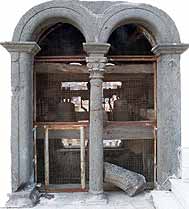





 Powered by DLC for