The 1860 Facts
The Antefacts
The 11 of May
1860, landing
of the Thousand, In the same historic port called by the Arabs,
1033 years earlier, Marsa-Ali. The men (1089 or 1092)
were already disembarked when turned up the corvette Stromboli
and the two steamships Capri and Partenone
commanded by William Acton, English and to the Bourbon service.
In the Marsala roadstead there were also the English
gunboats Argus and Intrepid, sent from Malta to cover the
landing.
The Acton, through binoculars, saw movements of men in red
shirts and thinking they were Red Coast of English troupes with
their superiors, did not open fire.
History is also made of little things: if Acton would have
carried out in full his duty the thousand would have failed like
Pisacane expedition, and Sicily history maybe would have been
written differently.
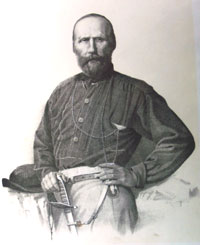
To the landing followed the various proclamations of Garibaldi,
the entry in Palermo, the battle of Milazzo, the surrender of
Messina.
Having conquered Palermo, according to a consolidated praxis (winners'
right), all acts drawn by the old rulers were
considered invalid and the possessions were given back to the
previous owners. The same would have happened in Bronte with the
Nelson dukedom. But Garibaldi, instead of declaring invalid "illic
et immediate" the gift to the Nelson of Bronte's land,
preferred not to adapt that same procedure.
At least so believed Bronte folks who didn't know what was
in the secret dispatch sent by the Dukedom administration to the
English vice consuls of Catania (Jeans), and of Messina (Richard), and that these were forwarded to the General
consul of Palermo (Goodwin).
This last one informed the Foreign Minister Russel
that, in his turn, overwhelmed with dispatches the dictator
Garibaldi and the governor of Catania.
Is worth remembering also that on the night of 5/6 of May
British ships had covered the departure of Garibaldi from
Quarto and that the British ha also financed the
undertaking with a public subscription.
At Catania there had been an agitation the 15 of May; the
General Clari, in one of his rapports of the 25/5, indicated
as members of the revolutionary committee the vice-consul
Jeans, together with Poulet, Casalotto, Marletta and
others.
The 31st of May Catania raised up and the Poulet squads, coming
down from Mascalucia, were winning over Clari's royals but
suddenly, at the arrival of the Gaetano Afan de Rivera's troupes,
the situation was reversed.
In spite of this, the 3rd of June arrived to the Catania
garrison the order to withdraw to Messina. |
|

The 1860 Facts
Garibaldi's Decrees
To put the
"facts of Bronte" in a better context it
is necessary to remember that the success of the thousand was
helped also by the rising of the farmers that were joining with
them. Therefore, in order to satisfy
the rural populations, Garibaldi took rapidly some important
social measures: abolished the tax on wheat grinding,
particularly hated, ordered the distribution, in
favor of poor farmers and soldiers, of land of the Council
properties.
Is also opportune to report the loll owing dictatorial
decrees:
19 May 1860:
From Passo di Renna Garibaldi decreed that the crimes committed during
the war, of any nature, committed by soldiers or civilians, would be
judged by a war's council
.
28 May 1860:
from Palermo, Garibaldi emanated a decree whose object was: Death
punishment for crimes related to robbery, homicide, sack and
devastation. Therefore such crimes were to be punished with
death, by being shot in the back; therefore nobody was
authorized to take revenge
by himself for anything, but had to claim
justice from the Government.
So were forbidden, in the most absolute way, all
those acts that could cause scenes of popular fury, and lynching of
supporters of the past Bourbon regime.
The decree established also that whoever with words or
writings would excite the people against such citizens would be
promptly arrested as guilty of "attempted murder".
If the persecuted person would be seriously
wounded, beaten or killed, the person or persons responsible would be
punished with death.
28 June 1860:
Decree called "Electoral
Law…" (etc.) that regulated for each Council the
composition of the electoral Committee, the choice of
the places for the meetings, the compilation of the
advises to announce publicly or to post up, the
transcription in registers of what was deliberated.
The lists had to contain name, surname, paternity, age,
profession and domicile of the elector that received a
ticket, signed and progressively numbered, to exhibit
before voting. Ultimately, was forbidden the inscription of persons
with rights in other quarters or out of the parish.

The 1860 Facts
The local situation
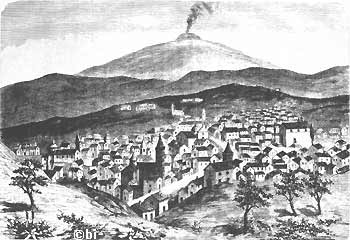
Bronte, in that year had a population of just over
10.000
inhabitants, many of which were
carrying agricultural or pastoral activities, (this information
comes from the so-called "riveli", that is
self declarations made under oath).
The new English masters, on the territory since
1799, had distorted the previous, precarious, social
equilibrium that had
caused further tension because of
the abolition of the "civic uses", wanted
by the Bourbon Government.
The ducal administrators, like true masters, subdued
the majority of workers, shutting the old paths that
made easier the access to their fields and asking,
with armed guardians, toll rights. |
|
|
Began cutting down the
woods to make charcoal to be sold to the
people of Bronte and in the same time prohibited
the entry in those woods and in the
others, to whoever used to go there for grazing, to
pick up wood, fruits or wild vegetables.
So, land before open to grazing, were shut down,
cultivated or sown. The transgressors, caught inside
the feuds by servile guardians, (even from Bronte), at
the Duke' service, practiced the right to whip,
heavily fine, even for the most trivial reasons, (usually for wood picked in the ducal woods), and
sometime put
in jail.
In few words, on the poor, disinherited
brontese peasants, the Dukedom exercised
"rights of vassalage" resting on
injustice and vexations.
Communal administrators, born in Bronte, piloted and
devoted to the "foreigners", used the "public authority"
in favor of the
English interest against that of the poor local population.
The common people then were brooding over ancient feelings of vengeance for having been wronged so
much, for the economic stagnation and the constant increasing of prices.
Barely the brontese people hide
their rage and dissatisfaction.
Writes Benedetto Radice, (Nino Bixio at Bronte):
«Were three hundred and fifty years
that Bronte was fighting for its rights, of which the fatal donations of the Pope Innocenzo VII in
1491 and of Ferdinando I in 1799 had deprived it from. Had seen its territory become smaller from day
to day, till complete disappearance for new rights, quibbles and claims…".
"Without saying - continues Leonardo
Sciascia in his book preface -, of the sexual
liberties that the gentlemen
used to take with the people's girls: and enough to
consider that in 1853 there were in Bronte, (on about 10.000 inhabitants), 38
communal wet nurses, to feed the bastards of
the ruota (the wheel)».
The occasion of the social redemption and of the end of so many centuries of injustice was given by the
arrival of Garibaldi in Sicily, by his swift victories over the Bourbons, by the proclaims of
breaking up civic councils, by the decrees regarding the land division and the abolition of the milling tax.
All this gave to the masses the cue to join
in "liberal committees" and try to
shake off, all at once, both the ducal masters and
also the "cappelli the hats"
that taking advantage of their hegemonic role under
the Bourbons, had embezzled state land.
With the breaking up of the Civic Council for dictatorial
decree, in Bronte had been also dismissed the Judge;
therefore the Governor of Catania, following the
usual pressing put on to him through
dispatches from the English General Consul Goodwin,
nominated Municipal President the citizen Sebastiano
Luca and Judge the lawyer Nunzio Cesare,
both of them friendly towards the Dukedom.
Should have kept in the proper count the just
expectations of the Communalists and of the
turbulent people that saw in the lawyer Nicola
Lombardo their chief, dividing the two important
offices in a more impartial way.
Not having been able to resist to the English
pressing, nor to ponder the delicacy of the
situation was a grave political mistake that had to
bring, shortly after, disastrous social repercussions.
In Bronte, unexplainable for the masses,
wasn't
abolished the milling tax that encumbered
over the poorest, but, above all, was not divided
the land of the Dukedom, given that, fallen the
Bourbon regime in Sicily, everybody believed
would have fallen also the donation made to the
Nelson.
The people, tired of being subjected to further
vexations, identifies in the "cappelli"
the land owners "ducal-Bourbons",
conservatives and oppressors; while who wants to
fight for the interests of the Council and stays
with the people is considered "liberal,
reactionary, anti-Bourbon".
Frustrated aspirations, thirst for revenge, rage and
ancient hatred push the lowest categories to extreme
consequences, and the 31st of July arrives the irreparable, even if the prudence and the
intervention of liberal citizen (among which
the same Nicolo Lombardo), try to restrain
the dreadful impetuosity of the people. |
|
|
|