«That bloodbath for a piece of lava»
In Bronte the word “communist” indicates the party, the popular faction that appealed for and demanded the restitution to the Council of the usurped land and its parceling out in opposition to the “ducal” party, in which the well-off class, supporting the great usurpation represented by the duchy were hiding their own small misdeeds. It is a very interesting municipal story and for the facts of August 1860 gets a case of conscience of the Italian state, of the nation; it says what the Risorgimento had not been, not realized ideas, hopes painfully frustrated for which we still feel pain and frustation. The divided stony ground of the original duchy, (only few hundred hectares remains to the hard heir of Nelson), is now neglected as anywhere in Sicily. To the same peasant coming back to Bronte from the north of Italy, from Germany or Belgium, to spend here his holidays, shall appear absurd and incredible that people of his condition, if not relatives, had been able to kill or to be killed for a piece of stony ground. “We want the “sciarelle!”, (small piece of lava ground), the shout of the drowned riot, is far and unreal, almost ridiculous, the feud looks now like a deserted lunar landscape. But it is strange to find oneself suddenly in the midst of it, facing the Castle of Maniace, surrounded by tall trees, wrapped in sound of water. And the trees and the water seem to evoke fog and you can have the illusion to stand on a piece of English country side. As anywhere man carries the image of his own country; and the English administrators of the duchy, even without realizing it, recreated here the ambience of their own faraway land. Entering the castle, which is actually the ancient Abbey of Saint Maria of Maniace, the suggestion gets deeper. In the court yard there is a cross of lava stone, only shaped differently to ours, studded, in memory of Nelson; In the church are buried the English feud administrators and their families; and for who knows something about the facts of 1860 would notice the name Thovez; as William and Frank Thovez were the administrators during that time. They, as their predecessors and successors in the administration of the feud, were able to recreate an English landscape around the castle, while the Sicilian reality was able to change them into Sicilians of the worse kind: mean, cunning, tortuous, very able to play both sides. Here, where the Greek Giorgio Maniace defeated in 1040 the Saracens, on the feud exactly called Saracina, Orazio Nelson and Nino Bixio’ s glory falls down in blood and injustice: Nelson accepted this land as payment for treason and a massacre, Bixio became an apostle of terror instead of justice. (Drawn from works 1971-1983 edited by Claude Ambrosie Bompiani’ s classics.) «Libertà»
"Libertà" is the most significant example of a short story that the Verga wrote inspiring himself to the fight between opposite classes and to the perennial violence of their relationship. In the various parts of the tale he makes correspond a historical moment and a diverse point of view. The initial part will have Saturday, August 4, as the date in which the riot against the "galantuomini" (gentlemen) explodes in all his violence and savagery. The point of view of the common men is highlighted here in a raising of enthusiasm and violence. Everything appears right and possible, be it the longing for economic and social equality, be it the thirst for revenge towards the wealthy dominant class. In the central part the short story describes the facts of Sunday August 5; it is strengthened the vision of the freedom as equitable distribution of the land and from it gleams an utilitarian and individualistic vision of the facts. The third part is divided in a three year period, from the arrival of the Garibaldians to the emission of the sentence of the appeal court towards the rebels. Here Verga makes prevail the middle class point of view:. "Freedom" only means violence and disturbance against an established order. The events run slowly, in a raising of indifference, while the defendants fall into the fatalism of who is not able to explain the reasons of its defeat. Of the bloody riot remains so only the pain of the accused, while life goes on as before. Everything remains the same, everything was useless, "in the air go only the rags". | |||||||||||||||||||||



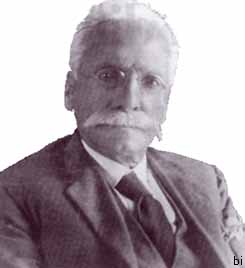

 The hunger for land, for this arid and black ground that with inexpressible patience and hard labor the men can change into gardens, here has generated bloody riots as that which, in August 1860, was blindly repressed by Nino Bixio at Biancavilla, Randazzo, Cesaro’, Bronte; and in Bronte with particular rigor as the hunger for land of the peasants applied also to the feud that the Bourbon king had given in1799 to the admiral Nelson, the famous dukedom of Bronte, the parceling out of which happened only recently, as this estate, besides the Bourbon king, had been usurped also in1491 by the Pope, and for centuries Bronte’s citizens had to fight for the rights of their Council over the feud, judicially and with tragic riots.
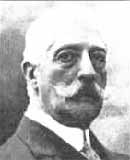 Besides Giuseppe Cesare Abba, also a great narrator of the level of Giovanni Verga, who, at the epoch of the facts, was 20 years old, dedicated to the dramatic rural riot of Bronte his short story, "Libertà" (Freedom). Freedom paid very dearly, tragic epilogue of the secular vassalage grown in the Nelson' shadow, in the rich Dukedom from 1799 settled in the castle.
|

 To remember and re-write the tragic facts of 1860, Bronte celebrated, after over a century, from the 17 to 19 October 1985, in the hall of the Capizzi College, a convention-process against Nino Bixio.
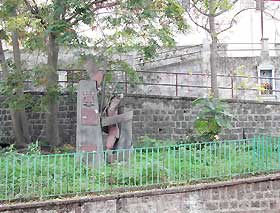 The lawyer Sebastiano Aleo, together to his younger friend Armando Radice, supported the charge, (for the defense were chosen Guido Ziccone and Cesare Zaccone) revealing themselves once more as two intransigent assertors of the fundamental rules of the right and democratic state.
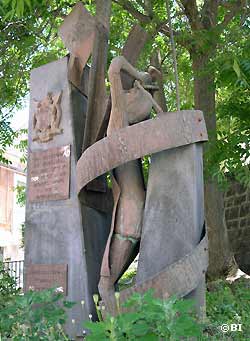 The convention-process acts, together with a severe reconstruction of the facts of Bronte, "The trial to Bixio" was published in 1991 by the publisher Giuseppe Maimone in the book cared by Salvatore Scalia.
| ||||||||||||||||||||
| ||||||||||||||||||||
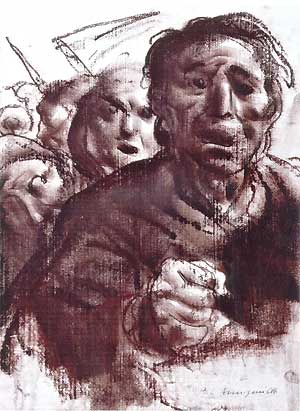
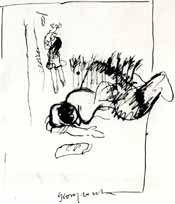
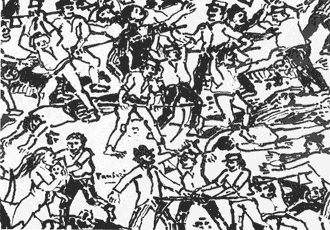

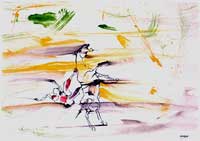
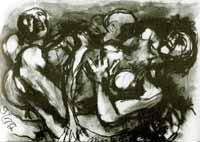
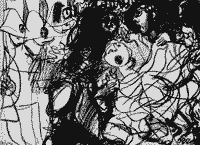
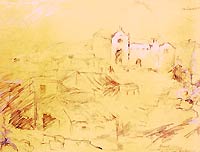

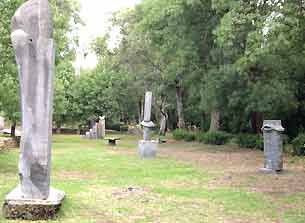
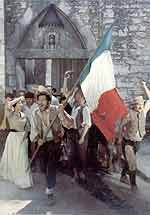
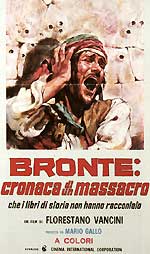

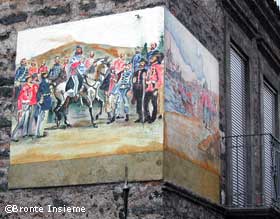 In Summer of 1860, armed with pitchforks and tricolor, Bronte's farmers move in to attack the duchess Nelson, heir of that admiral Horatio to whom Ferdinando IV had granted the title for services rendered in the liquidation of the republic of the 1799.




 Powered by Associazione Bronte Insieme -