“…The hospital church and the hospital itself. because of their foundation are effective property of the compagnia dei Bianchi, who started it and, made, in part, with its money and completed them with the income of its Chapel Castiglione (the legacy of the Baron Castiglione-Pace): so the compagnia dei Bianchi is the effective founder of both works”. (Gesualdo De Luca, "Legal memory the joint ownership and the possession of the Compagnia dei Bianchi on the public church of Bronte' hospital", Catania, Tipografia Galatola, 1882). The Hospital of the poor that functioned all 1800, however, was small and inadequate to the needs of a growing population. Besides, in 1882, because of the widening of Corso Umberto, part of the building was knocked down while the patients were recovered in the Capuchin convent. 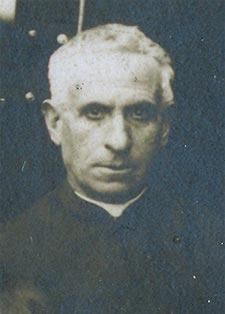 Bronte then had 20.000 inhabitants, tuberculosis and other contagious diseases (see cholera epidemics) were decimating the people: “the poor ones were dying in their own hovels, with no assistance or comfort, and often were dying of starvation and desperation: the infections used to spread with a dreadful crescendo, because nobody took care of hygiene in the houses and in the streets, for poverty, ignorance, insipience, or for guilty carelessness”. Bronte then had 20.000 inhabitants, tuberculosis and other contagious diseases (see cholera epidemics) were decimating the people: “the poor ones were dying in their own hovels, with no assistance or comfort, and often were dying of starvation and desperation: the infections used to spread with a dreadful crescendo, because nobody took care of hygiene in the houses and in the streets, for poverty, ignorance, insipience, or for guilty carelessness”.
The class of more indigent citizen was “compelled to implore for being recovered in hospitals of the provincial towns, as a grace more than a right”. The idea to realize a new hospital came to the priest Giuseppe Prestianni (1849-1924, photo on the right), well deserving rector of the Real Capizzi College from 1892 to 1916, who, with his own money bought some houses and a quantity of lava ground, in the provincial road, that was outside the town boundary fence, below the railway station of the Circumetnea, between the actual M. Pagano street and Corso Umberto. The site' choice was not a particularly good one: in elevated position but in a cramped space close to a lava wall (was written then “to repair it from the north winds”) and surrounded by houses. “However, writes Benedetto Radice, to the priest Prestianni, business man and stubborn, was lacking the sense of esthetic beauty. … the Hospital could have been built in Salice district, or better at the Conventazzo district, as had been ordered in 1574 by monsignor Ludovico Torres in his pastoral visit”. 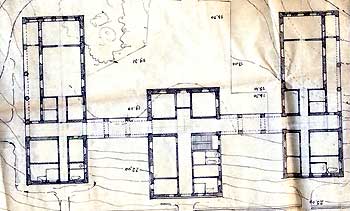 The Prestianni spent "of his own money" over 70.000 lire; obtained another 20.000 lire from the Council (voted the 28.1.1901); and other 20.000 lire were recovered from the sale of the old hospital and other areas that belonged to the Capuchin convent; other sums were contributed by well deserving benefactors and public subscriptions. The Prestianni spent "of his own money" over 70.000 lire; obtained another 20.000 lire from the Council (voted the 28.1.1901); and other 20.000 lire were recovered from the sale of the old hospital and other areas that belonged to the Capuchin convent; other sums were contributed by well deserving benefactors and public subscriptions.
To realize such work wasn't certainly easy, the means necessary to the construction were consistent but Prestianni was “cocciuto” (stubborn) like Ignazio Capizzi and the new hospital was tenaciously wanted by everybody. The brontese people who contributed to the construction were very many: with the subscriptions were gathered about 48.000 lire, also the emigrants sent their offers (a big contribution of 6.272,35 lire were given by an Association of brontese emigrants from the far away America, the Society "M. S. N. Spedalieri"), the Bronte's workers gave to the new hospital one day' wages. The Cassa Agraria di Mutuo, (Mutual Agricultural Bank, the actual Popular Bank), devolved for some years its profits to the completion of the central building (balances 1921, 1922 and 1923 for a total of 28.000 Lire), and there were also testamentary legacies in favor of the new hospital (of doctor Filippo Isola, of lieutenant Nunzio Aidala, of Pietro Spedalieri and others). 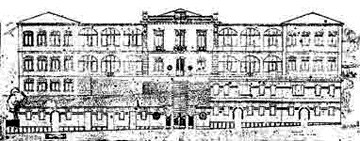 The project for the construction of the new hospital was drafted by the Architect Leandro Caselli (the same that projected in 1892 the new wing of the Capizzi College) and comprised three multistoried structures, one in the center and two on the sides, communicating with the first "through covered arcades". The project for the construction of the new hospital was drafted by the Architect Leandro Caselli (the same that projected in 1892 the new wing of the Capizzi College) and comprised three multistoried structures, one in the center and two on the sides, communicating with the first "through covered arcades".
Initially could hospitalize 60 patients beside the medical staff, the well deserving sisters, the attendants, kitchens, stores, and lodging of the custodian (in the same period the four big hospitals of Catania could provide 800 beds). The project should have provided also an ample entry on the principal prospect of the edifice (63,30 meters long); should have been built on via Pagano, "which should have been properly put in order, in a way that after the expropriation and demolition of the adjacent houses, the road bed would have been considerably enlarged and lowered"; however, principally for the excessive cost, (over 10.000 lire), the ample entry, designed by the architect Caselli was never totally realized. The work was interrupted during the war (1915-1918), began again in 1921 and the first pavilion was inaugurated the 3 February 1923. 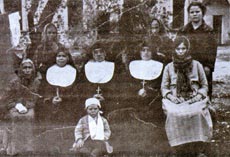 Few years later was completed the western pavilion that comprised in the ground floor the kitchen, the ovens, the pantries, the stores, the laundry, the disinfection's room and, on the first and second floor, "the common infirmaries and those in separate rooms, that is with male and female wards" (altogether 29 beds). Few years later was completed the western pavilion that comprised in the ground floor the kitchen, the ovens, the pantries, the stores, the laundry, the disinfection's room and, on the first and second floor, "the common infirmaries and those in separate rooms, that is with male and female wards" (altogether 29 beds).
After the death of father Prestianni (1924) another priest, Benedetto Ciraldo and the local Charity Congregation (the ex Compagnia dei Bianchi), continued the completion of the work. Continued also the unceasing , generous contribute and the offers of the brontese people for the acquisition of the furniture, the linen, the surgical instruments and the pharmaceutical material. In March 1925 the Charity Congregation had a debt of 19.010,70 lire, "to be extinguished with the offer promised by the Cassa Agraria di Mutuo (Mutual Agrarian Bank) over the 1924 balance and with the generous donations of other boards and benefactors". 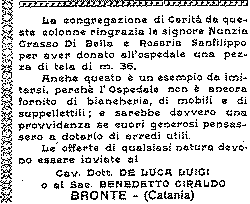 Lastly was built the eastern pavilion, composed by ground floor and first floor for a total of 29 beds. Lastly was built the eastern pavilion, composed by ground floor and first floor for a total of 29 beds.
The historian Benedetto Radice printed in 1926 his “Historic Memories of Bronte” “in favor of the Civic Hospital” to which devolved also the literary property. Still in 1949 the "Brontesi of America" opened public subscriptions "to meet the needs of our hospital".
Like to remember a small list of subscriptions (among the many published by the fortnightly "Il Ciclope" in those years): J. Sam and Vincenzo D'amico, Nunzio Camuto, Pietro Saitta, Joseph Lupo, Salvatore Portaro, Vincenzo, Walter and Nick Gangi , Luigi Isola, Joseph Barbaria, Frank Casella, Vito Palermo, Sebastiano Caudullo, Vincenzo Fiorenza. Concluding the pious work that conducted "Hospital of the poor” following a unanimous vote of the Council was deliberated to entitle the new construction “Ospedale Castiglione Prestianni” with the names of the two principal founders and benefactors.
| 


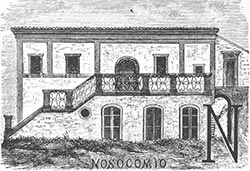
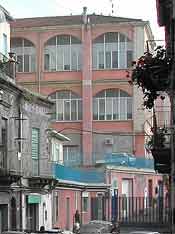 The hospitals in, the past centuries, were instituted and conducted by the church, the Councils, but also, for the Christian charity and help freely offered, by private benefactors, by confraternities and associations.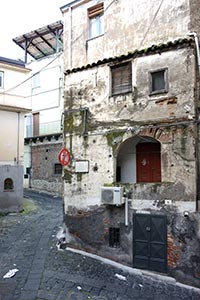
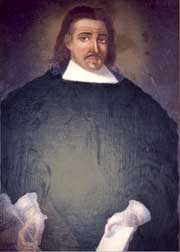
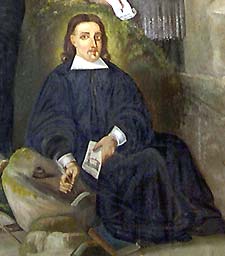 B. Radice writes that "Don Lorenzo Castiglione, baron of Pietrabianca, in that of Adernò, to do something grateful to the Municipality, which he had a generous spirit, and to make payment less difficult, bought the installment ... which Bronte owed; and paying the capital to the Royal Court ... was invested with the title of Baron of St. Louis ... ».
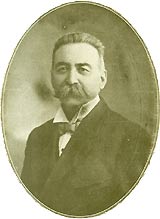 The doctor Filippo Isola, one of the major benefactors that gave part of his wealth in favor of the poor's hospital.
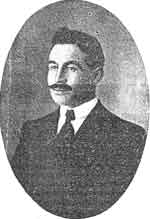 A famous benefactor of the hospital was the young lieutenant Nunzio Aidala, son of the notary Giuseppe. Born in Bronte the 26.2.1889, wounded on the S. Marco the 15.11.1916 died the day after at Gorizia.
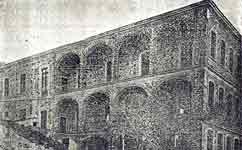 Two old photos of the construction of the Hospital (1925).
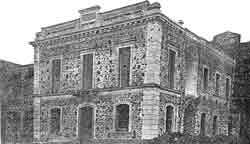 For economic reasons, the original project of the Caselli, was somehow reduced: were eliminated a second and third floors, foreseen on the central pavilion, whose first floor was adequately elevated in relation to the height of the lateral pavilions, the ample entry with flight of steps from Via Pagano was not realized.
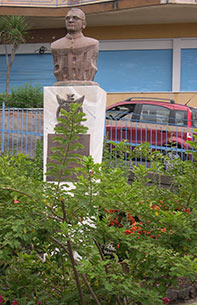
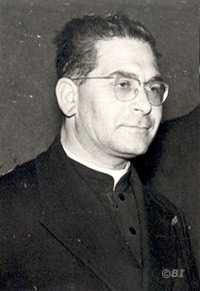 Yet another brontese priest, Antonino Rubino, elected in 1952 President of the "Castiglione Prestianni", continued for a quarter of century the work of Giuseppe Prestianni and of Benedetto Ciraldo, strengthening the organization and the internal structures of the Hospital and modernizing the ancient infirmary with the creation of divisions of medicine, surgery, obstetrics, gynecology, pediatrics, and laboratories of analysis and radiology.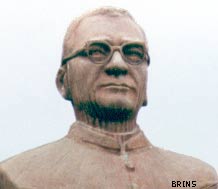




 Powered by Associazione Bronte Insieme - Reproduction not permitted even if partial - Last adjournment: 04-2024