Bronte's History
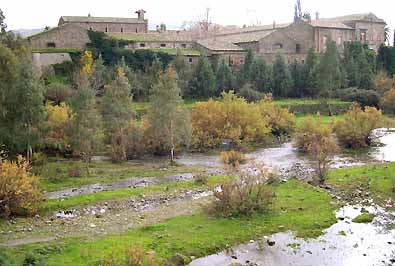
The Maniace Abbey 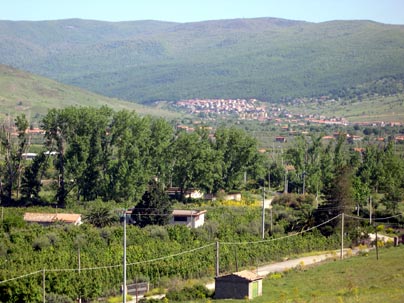 Up to very recent times, an important part of Bronte's territory (among which a large, fertile valley, close to the Saraceno torrent, on the oriental bank surrounded by centenary trees, called Contrada Maniace, from 1961 autonomous Municipality) was property of the heirs of Horatio Nelson, the Trafalgar battle hero. Up to very recent times, an important part of Bronte's territory (among which a large, fertile valley, close to the Saraceno torrent, on the oriental bank surrounded by centenary trees, called Contrada Maniace, from 1961 autonomous Municipality) was property of the heirs of Horatio Nelson, the Trafalgar battle hero.
In ancient times in the place rose a village populated by Arabs and natives, with an impressive Castle, known as Ghiran-‘ad-Daquid (flour grottos) and a hermitage or grangia basiliana. An Arab community had settled there already in the first years of the XI° century, when the primitive name Simeto, had been changed in the Arab Ghiran-‘ad-Daqiq. We know (from Idrisi, Arab geographer, traveler for the Norman Court of Sicily), that during the XII° century Maniace was a thriving village, in flat ground, with a market and merchants, fertile land and abundance everywhere: «This, also called Ghiran-‘Ad Daqiq is a village in flat ground, well populated, and has a market and some merchants; (land) fertile and abundance in every way...» (The book by Ruggero). The Arab domination coincides in fact with a brilliant economic recovery of the zone thanks to original and decisive innovations in the agriculture' field. All in all, the Arab domination can be considered one of the best in our history.
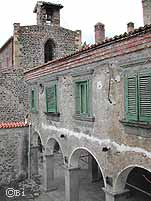 In Bronte, in our arid and hostile stony grounds, the Arabs, good farmers, transplanted the pistachio that, even today, represents the most important item in the local economy. In Bronte, in our arid and hostile stony grounds, the Arabs, good farmers, transplanted the pistachio that, even today, represents the most important item in the local economy. In 1040 The valley was theater of a war event of great proportions that, with others together, brought about the expulsion of the Arabs from Sicily: the clash of the Saracens against the Norman-Byzantine soldiers, commanded by the general Giorgio Maniace, sent from Byzanthium. Gesualdo De Luca, in his "History of the city of Bronte", of the 1883, tells that «… rushed with such force the Christian army against the enemy, that of Saracens 50.000 were killed while the others run away in solemn defeat and a very happy victory was achieved by the Christian army.» In memory of the bloody, victorious battle, the place, in his honor, was called Maniace and, in the battle area, was erected a church, to which was given the name of Santa Maria di Maniace, and built a small monastery, subsequently destroyeid by an earthquake. In the following century, year 1174, the Normans, having become masters of Sicily, started a political, administrative and religious reorganization of the entire conquered territory, so contributing to the construction of churches and monasteries.
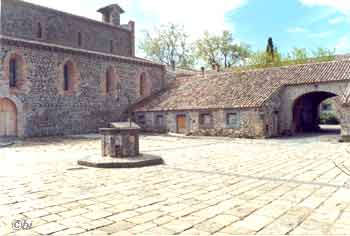 It was so that Guglielmo II° il Buono (the good one), for an express wish of his mother, the Queen Margherita of Navarra, built, on the ruins of the old hermitage, an Abbey dedicated to Maria Santissima, entrusted, in the following centuries, to Benedictine and Basilians. It was so that Guglielmo II° il Buono (the good one), for an express wish of his mother, the Queen Margherita of Navarra, built, on the ruins of the old hermitage, an Abbey dedicated to Maria Santissima, entrusted, in the following centuries, to Benedictine and Basilians. The first Abbot of the Benedictine monastery was the French man Guglielmo di Blois, latin poet and a man famous in his time everywhere for his great and refined culture. Subsequently an other abbot, the Blessed Guglielmo, was the chief of the anti-aragonite, conspiracy known as the "Randazzo Conspiracy", plotted in 1285, but ended in tragedy with the killing of the promoters and the exile of the abbot to the island of Malta (the tomb of the Abbot Guglielmo is in the church of Santa Maria). The decadence of Maniace begins around 1392 with the Commended Abbots nominated by various kings of the time. The administration of the Abbey was taken away from the monks and entrusted to the commended Abbot who could dispose of all the abbey's properties leaving to the monks a small annuity to live on. 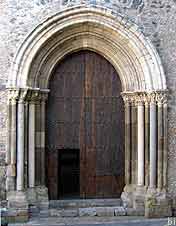 The last commended abbot of the Abbey was the cardinal Rodrigo Borgia, future pope Alexander VI. The last commended abbot of the Abbey was the cardinal Rodrigo Borgia, future pope Alexander VI.
The last monks who lived in the Abbey were the Basilian who, after the 1693 earthquake that hit oriental Sicily, were forced to move to the near Bronte, in the San Blandano church, where they erected a new small monastery and where they lived and and operated till their suppression (1866). On 4 September 1981, the last heir of the admiral Nelson, the duke Alexander Nelson Hood viscount Bridport, sold to the Council of Bronte all the architectonic complex comprising the ancient Abbey. The Nelson Duchy with the Santa Maria church of Maniace, the noble apartments of the Nelson (today changed in Nelson Museum), the ancent Benedictine Abbey, and the Park (with the extraordinary Open air sculture Museum) have become a center of great tourist attraction of particular interest.
| 



 The vicissitudes of Bronte and of his territory, gone from a master to another, are strictly bound to the history of the




 Powered by Associazione Bronte Insieme - Reproduction not permitted even if partial - Last adjournment: 04-2024