The Capizzi college
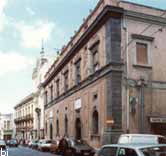
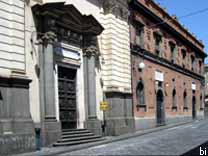
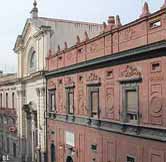
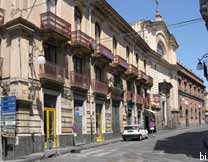
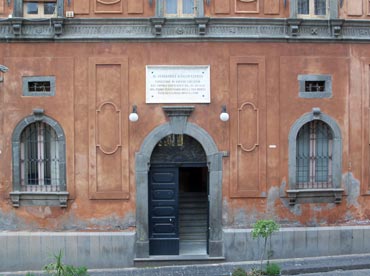
Architectonic structure The building, a square structure with internal courtyards, is very large and occupies the whole perimeter of the block, bound by Corso Umberto and the other streets, Cardinal Deluca, Attina' and Capizzi. Stands in the part of the town built between the end of the XVIII and the beginning of the XIX century. The changed disposition of urban volumes have somewhat altered the architectural relationship with the adjacent buildings, without however changing, to any extent, the perspective. The close vision, from across the road not particularly wide, still allows a detailed reading of the refined wall decorations. | The more ancient monumental part of the complex was built on tree levels and a basement (with a gym, the kitchens, laundry and the stables). A beautiful horizontal strip of lava stone shows the separation of the street frontage levels. The regular rhythm of the openings is alternate to the repetitive and geometrical forms of the wall decorations. The crowning in masonry (feigned balustrade) closes the façade above an overhanging cornice. 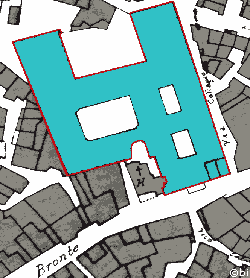 On the cornices, on the windows pediments and on the floor showing strip there are sculpted, in bas-relief of lava stone, ornamental motifs of rare fineness. On the cornices, on the windows pediments and on the floor showing strip there are sculpted, in bas-relief of lava stone, ornamental motifs of rare fineness.
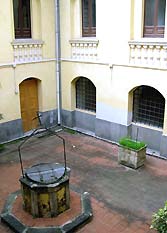
At the center of the architraves stand out some images of human faces. The lot is crowned by swags with paper coil and shell of baroque taste. The services are placed at the basement of the building; the gymnasium opens on one of the big internal courtyards; the class rooms and the dormitories are in ground and first floor. 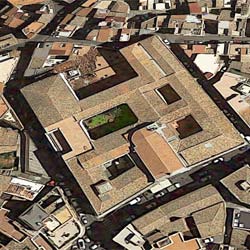 Two courtyards internal to the complex and the "little garden" determine the articulation of class rooms and corridors. Two courtyards internal to the complex and the "little garden" determine the articulation of class rooms and corridors.
The rooms in the basement, looking on via Cardinal De Luca (that up to not long ago contained a bank) are now being restructured to become the art gallery of Bronte. The oldest part of the college in a map of 1875. Can still be seen the plan of the little San Rocco chapel which was in a corner of the building with a side small street.
The chapel was demolished in 1907 to make room for the construction of the Sacred Hearth church. To be noted also that the left part of the College was leaning over houses where today there is Cardinal De Luca street.
| "Many people know Bronte for the heartless executions by firing squad ordered by Bixio in 1860; not so many for things related to the Maniace Abbey and the Nelson Dukedom or the importance of the town as a cultural center, for more than a century, in nearly all of Sicily: the Capizzi College and boarding school, unique in a rural center, founded by the diocesan priest Ignazio Capizzi. Bronte, agro-pastoral village, similar to many in the island, non Jesuitical center, has to fight against nature (Etna devastating eruptions) and against the Nelson Dukedom, but finds in the pride of its citizens and in the creative intelligence of one of its sons, Ignazio Capizzi, the strength to bring it to history's attention. Deserves, therefore, absolutely, a particular mention. Furthermore, it's not enough to create something as to make it grow and prosper with a constant organizational and cultural action to make it last.
This was the merit of a number of people of Bronte, committed in the role of managers and teachers who were not engaged from outside but were selected only between the best local elements. The hard journey of that population, always trying to redeem itself from the ransom in which the various Nelson, Bixio or Garibaldi kept it through economic interests and the continuous adhesion to an old culture, unable to percept the needs of new and changed times. (Salvatore Cucinotta, "Sicily e Sicilians", Sicilian Editions Messina, 1996) |
|
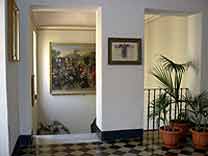
| Over the stairs that take to the Direction with the picture “Illustrious Bronte’s men”. A large oil paint canvas by Agostino Attina’ of the 1874. |
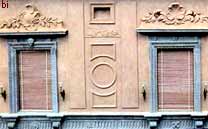
Details of the main façade of the Corso Umberto: on the cornices and trabeations of the windows and on the string course there are the ornamental bas-relief motifs carved in lava stone of rare finesse.
At the center of the architraves are carved some figures of human faces. The whole is crowned with festoons with cartouche and shell of baroque taste. | 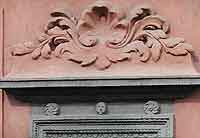 | 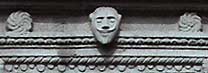 | 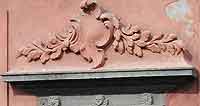 | 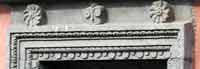 |
|
|