| ||||||||||||||||||||
| ||||||||||||||||||||
| ||||||||||
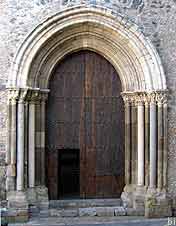
The wonderful Gothic portal, which is worth becoming a national monument, is work of great artistic value going back, probably, at the first years of the foundation of the abbey. The Gothic disposition of volumes follows the nervous modulation of the bases on which it is set up. The frame is adorned with several cordons, big and small, vaguely shaped and jutting out. Three of the moldings plants reproduce big sea cables. Two groups of side smooth and round little columns, of sandstone, marble and granite, support the big arch. | ||||||||||
| ||||||||||
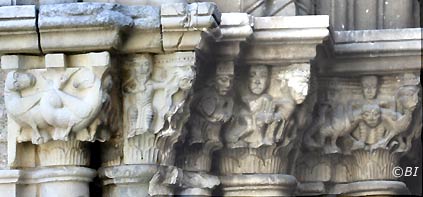
The sculpted figures are little caryatids leaning on splendid basins adorned with acanthus leaves worked to embroidery. Depict scenes of the world creation, but also scenes whose interpretation remains very mysterious (like the woman's bodies mingled with monstrous beings), in spite of the precise description that Benedetto Radice made. Similar sculptures were found in churches and Benedictine monasteries risen in the XII century in Sicily. Are in a particular way the disquieting figures represented in the left capitals (for who looks) to place the question of the real meaning of this sculptural representation. Inspired to the "medieval bestiaries" the figures describe monstrous beings, misshapen, maybe symbols of the vices of the human kind. They tell histories of lust seen through the weaving of the female body with satyrs, from the inflated belly and hairy legs of griffon, and wrapped snakes to the members. Hopeless scenes of damned and terrifying scenes of bodies and misshapen faces and every other physical monstrosity. Instead the figures of the capitals at right, symbolically composed, tell the events of the human kind starting with the expulsion from the Terrestrial Heaven and Abel's killing.
While the right capitals tell, those of left are the logical contradiction, the negation of any narration and history itself, the allegory of the human kind carried away by the temptations and the sin. This is the interpretation of the figures carved in the capitals of the portal in 1923 Benedetto Radice. But the Root was a historian and certainly not a medieval art expert. In the description then went to meet some inaccuracy. Recently an extremely interesting article was published entitled "Sculture medioevali a Bronte" (Medieval sculptures in Bronte) by Ada Aragona and Claudio Saporetti (the latter professor of Assyriology who also worked on medieval art, on Ciprominoico and Greek Archeology) in which the authors correct the errors of the Root and "reveal" with a wealth of arguments and details another meaning of some representations of the capitals of the portal whose interpretation, however, despite the various hypotheses, still remains very mysterious. "Benedetto Radice - write Ada Aragona and Claudio Saporetti (Sheet of Art, A. VII, No. 1 January 1984, pages 19-24) - described the scene of the capitals by making numerous and naive errors. In the left capitals he sees men, animals and birds with a monkey's face, and a snake that twists and winds, and which bites the mouth to a mask, like figures that act as little caryatids. | ||||||||||
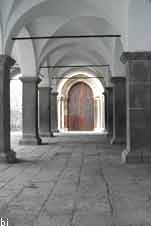
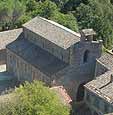
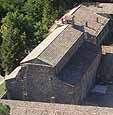
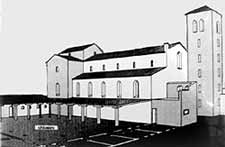
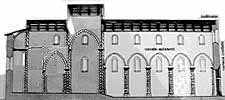
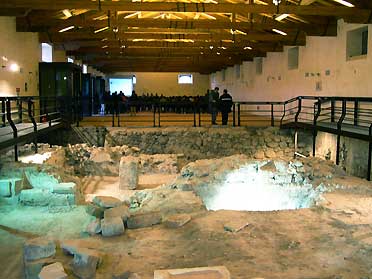
If it is possible to recall of the entire monastery only a functional and constituent outline, of the church it is possible, by means of typological analysis and with the supply of architectural remains, to advance a more consistent reconstruction hypothesis. The sandstone elements on the back wall of the church (the posts of the central nave and the Gothic arch on the nave of the right) the ruins of the apses dug up during the repairs, the memory of the two elements in front of the church, of which only the one on the right remains, traces of a probable front portico, identify the architecture of the Santa Maria of Maniace’ church as a clear work of Benedictine school, brought in Sicily during the Norman period by the Cluny’s monks. The church, with its basilical, longitudinal body with a nave and two side aisle, wooden roofing, high presbytery with three apses looking east, shallow transept and vestibules realized as two towers alongside the prospect, had nearly double the dept it has now and was characterised by the two-colour in the lava stone ashlars of the squat hexagonal and circular pilasters placed over cubic base and the shape of the pointed arches, only trace of oriental derivation. The intersection must have been covered with a square lantern tower, as the dimension of the cross-shaped pilasters set in yellow sandstone ashlars doesn’t justify the existence of a dome. The high presbytery and the edifice’s remarkable length probably gave a certain grandeur to the space that should have given also a great rustic sensation, non showing traces of internal or external decorations or coverings. The spatial affinity of Santa Maria di Maniace with the cathedral of Cefalu’, erected from 1131 to1148, and with the contemporaneous Monreale cathedral, erected in 1174 by Guglielmo ii, appear evident.
Stories and proposals in Maniace by Alvise Spadaro
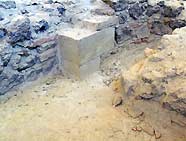
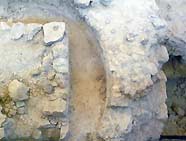
During an inspection carried out in recent months along the perimeter of the town, under the wall of the granary behind the church it was possible to detect the final part of the base of the central apse. The fortunate discovery allows us to re-propose the hypothesis, published here for the first time, with the addition of the new element which, if nothing else, allows us to define, this time with certainty, the original length of the Norman temple which thus appears having been almost double the size of the existing part in elevation. Certainly this definition is not of exclusive architectural interest since, the simultaneous construction in eastern Sicily of the great church of Santa Maria di Maniace (1173) and in western Sicily of Santa Maria Nuova (1173) the cathedral of Monreale, in both cases with an adjoining Benedictine abbey and whose monastic nuclei initially came from the coenobium of Cava dei Tirreni, could provide medievalists with different ideas for the study of the relationships between the Island and the Peninsula and for a fine-tuning of the various aspects of the Norman period in Sicily during which the island rose to the role of cultural, political, economic and social reference in the European context. (Alvise Spadaro) | |||||||||||||
| |||||||||||||
| |||||||||||||
| |||||||||||||





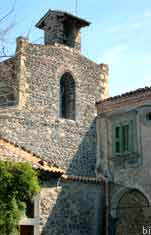
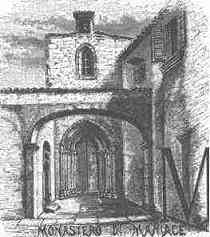 The Church Of Santa Maria Of Maniace, typical basilica church, is included in the volumes disposition of the Nelson Duchy complex.
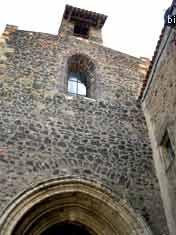 The most complete testimony of how a church had to be until the XVII century is of Giovanni Angelo De Cocchis which visited the monastery about 1741 and took a few testimonies given by other visitors again in 1579, before the terrible earthquake of 1693.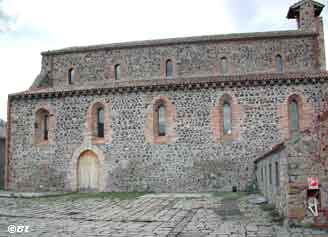
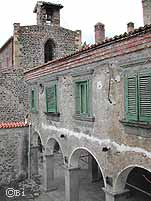
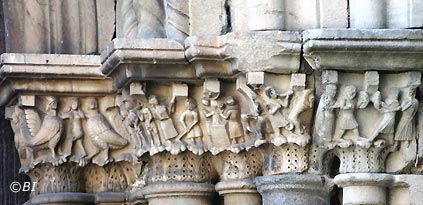
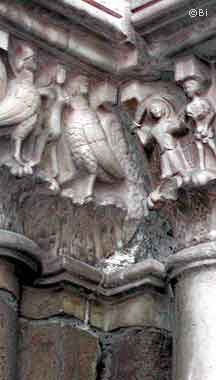 The capitals which connect the structure have a stylistic form which sends again to analogous works executed in Monreale, seat of the Episcopal jurisdiction.
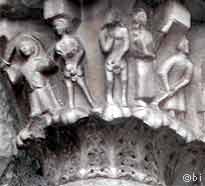 Every capital develops a different theme: the work in the fields, the hunt, the war.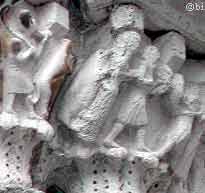
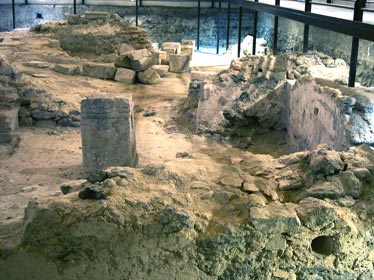 What remains of the monastery, after the earthquake of 1693, is currently buried under the palace and factories of the Duchy of Nelson, (so-called because on 10 October 1799 it was donated by Ferdinand III together with the title of Duke of Bronte to the admiral Orazio Nelson to reward him for the help provided to him in the repression of the uprisings in Naples), but the church which remained in elevation seemed to lack only the apse part, until, following survey operations carried out by the writer, some traces were found which were a prelude to the lack of the entire presbytery part: a study, as detailed as possible, together with a prudent attempt at a planimetric reconstruction of the Norman temple, was published in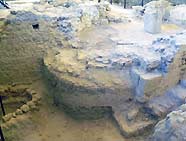
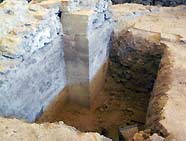
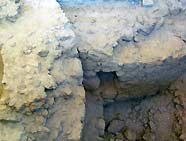
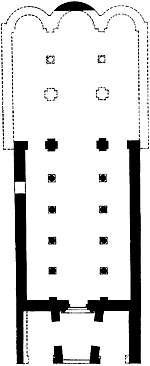 Hypothesis of planimetric reconstruction (hatched in the drawing below) of the church of Santa Maria di Maniace (1174) made by the architect. Alvise Spadaro in 1987.
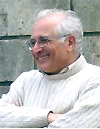 ALVISE SPADARO, architect, honorary inspector of cultural heritage, art historian, as well as the restoration of monuments, he also dealt with history and writing at the time of the first dynasties of Ancient Egypt and wrote numerous contributions on history and culture Sicilian. He is also the author of short stories and works of fiction, he has published, among other things, "Settecento Calatino" (Catania 2000); Caravaggio in Sicily (Catania 2005); Caravaggio in Sicily - the lost path (Acireale-Rome 2008); The mystery of the stolen Caravaggio and its Catanese copy (Acireale-Rome 2010) and, lastly, Le Travestite - women in history (Acireale-Rome 2011).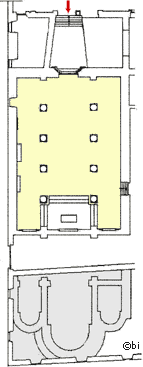


 Powered by DLC / Reproduction not permitted even if partial - Last adjournment:
02-2025
Powered by DLC / Reproduction not permitted even if partial - Last adjournment:
02-2025

